
Heydar Aliyev International
Taxi past the distinctive curves of Terminal 1 on an airfield with custom stand markings and locally based aircraft.
Baku, Azerbaijan Map
FSX, FSX: Steam Edition & Prepar3D
Fly from the shores of the Caspian Sea to Heydar Aliyev International, with Baku’s waterfront skyline beyond the airport.
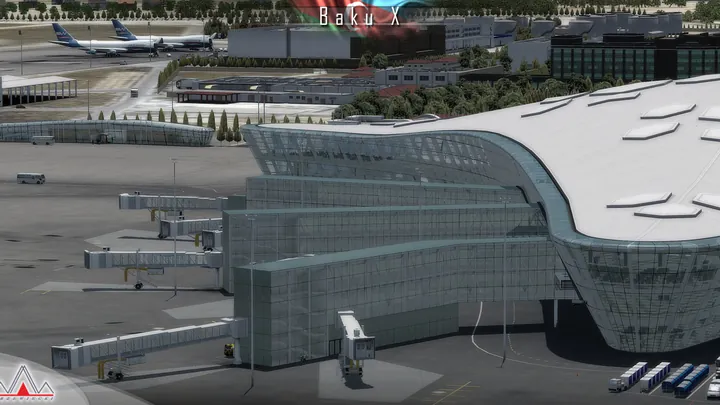
Taxi past the distinctive curves of Terminal 1 on an airfield with custom stand markings and locally based aircraft.
Look inside Terminal 1, the control tower and the Silk Way hangar.
Custom landmarks and night textures trace the city along the shore of the Caspian Sea.
SODE animates the jetways. Visual docking guidance is available in FSX and through SODE in Prepar3D.
Rain effects, animated objects and static aircraft bring the apron to life. Prepar3D v4 and later add dynamic lighting.
The included UBBB charts cover the airport depicted in this edition.


Designed for FSX, FSX: Steam Edition and Prepar3D v1–v5. Works with Drzewiecki Design, Orbx, PILOT’S and MegaScenery. Disable overlapping airport scenery for the same location.
Install SimObject Display Engine (SODE), then run the scenery installer. It registers the scenery in the simulator library. Run it again to change options. The manual covers removal.
Customer support has ended for this edition. No further updates will be released.
Baku occupies the southern shore of Azerbaijan’s Absheron Peninsula, where the land curves around a sheltered bay on the Caspian Sea. The old walled city stands just inland from the waterfront boulevard. Farther along the same shore, the harbour, former oil districts and modern towers trace the growth of a city built around maritime trade and petroleum.
Heydar Aliyev International Airport (UBBB) lies about 20 kilometres northeast of central Baku, near the settlement of Binə. Known for many years as Bina Airport, it took its present name in 2004. The airport grew on the open peninsula, away from the dense streets around the bay, with room for two runways and extensive cargo and maintenance facilities.
Two generations of passenger buildings stand side by side. The terminal that opened in 1999 was joined in 2014 by Terminal 1, with its curved apron frontage. The stands around the two buildings form the passenger hub. The separate freight aprons and large maintenance hangars show how much of the airport’s working life takes place away from the gates.
Included airfields · UBBB, UBTT, UB18


